Ash Crypto Net Worth 2026: Bio, Track Record and Allegations
Ash Crypto (@AshCrypto) has 2.1 million X followers. We check his bio, the net worth claims, his public market calls and the May 2026 ZachXBT allegations.
Canada taxes 50% of crypto capital gains and 100% of business income. How to calculate ACB, fill in Schedule 3 and T1135, and what CARF changes from 2027.

By Mikko Mikailov7 min read
Canada has no separate crypto tax. The CRA treats crypto as property, so each sale, swap or payment in crypto is a disposition that produces either a capital gain, of which 50% is taxable, or business income, which is taxed in full. For the 2026 tax year the return is due on 30 April 2027, and anyone holding crypto on foreign platforms with a total cost above $100,000 also files Form T1135. From 2027, platforms serving Canadians are set to report user transactions to the CRA under CARF.
The CRA's position follows from one classification: crypto is property, not money. Every disposition is measured in Canadian dollars at fair market value on the day it happens.
These transactions are taxable:
These are not taxable on their own:
The CRA has not published crypto-specific rules on staking or DeFi. Tax practitioners treat staking rewards as income when received, and the value at receipt becomes the cost base when the coins are later sold. Where the guidance is thin, the general rules apply.
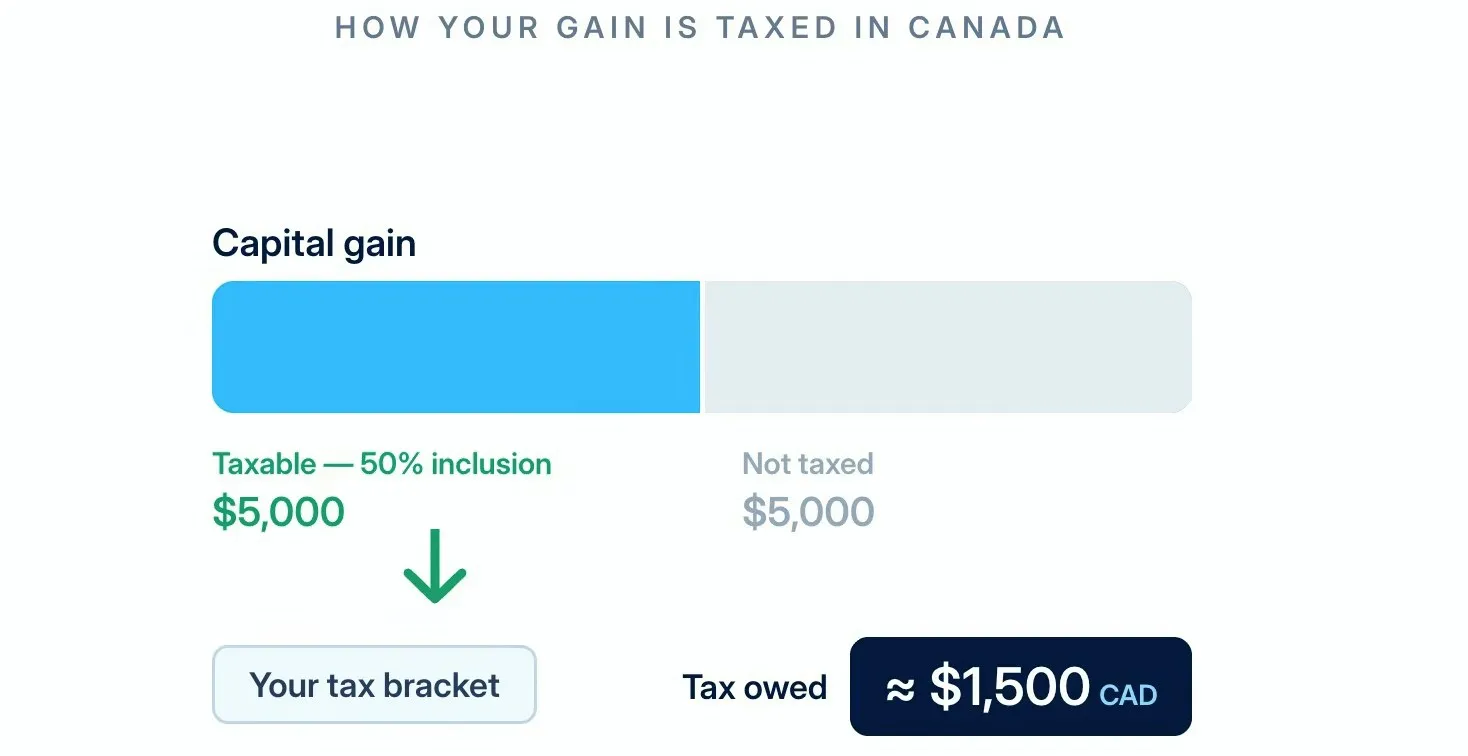
The same $10,000 profit produces two different tax bills depending on how the CRA reads your activity. As a capital gain, $5,000 enters taxable income. As business income, all $10,000 does.
The Income Tax Act has no bright-line test. The CRA looks at a pattern of facts:
An investor who buys bitcoin twice a year and sells after three years sits on the capital side. A person running hundreds of futures trades a month sits on the business side. The majority fall between, and the burden of supporting a position rests with the taxpayer.
Surprisingly, a number of 2026 guides still describe a 66.67% inclusion rate on gains above $250,000. That rule was proposed in Budget 2024, deferred, and cancelled on 21 March 2025. For individuals the inclusion rate is 50% on all capital gains in the 2026 tax year. Business income is not affected by inclusion rates at all. It is taxed at your full marginal rate, which in Ontario reaches 53.53% at the top bracket.
Capital losses work in mirror image. Half of a capital loss is an allowable capital loss. It offsets taxable capital gains only, not employment income, and unused amounts carry back three years or forward indefinitely.
Canada requires the average cost method for identical property. You cannot pick which coins you sold, as is allowed in the United States. Every purchase of the same coin blends into one adjusted cost base (ACB), and fees paid to acquire the coin are added to it.
The example below shows two purchases and one partial sale of bitcoin:
| Transaction | Amount | CAD value | Fee | Running ACB |
|---|---|---|---|---|
| Buy | 0.5 BTC | $40,000 | $40 | $40,040 for 0.5 BTC |
| Buy | 0.5 BTC | $60,000 | $60 | $100,100 for 1.0 BTC |
| Sell | 0.4 BTC | $50,000 | $50 | $60,060 for 0.6 BTC |
The ACB of the 0.4 BTC sold is 40% of $100,100, or $40,040. The capital gain is $50,000 minus the $50 selling fee minus $40,040, which equals $9,910. Taxable capital gain at 50% inclusion is $4,955, added to income for the year.
Swaps follow the same logic. Trading 1 ETH for 3,000 USDC disposes of the ETH at the CAD value of the USDC received, and that value becomes the ACB of the USDC.
Selling at a loss to cut your tax bill and buying straight back does not work. If you, your spouse or a corporation you control acquire the identical coin within 30 days before or after the sale, and still hold it at the end of that window, the loss is denied. The denied amount is added to the ACB of the repurchased coin, so the loss is deferred rather than erased. Whether wrapped or bridged versions of a coin count as identical property is a question the CRA has not answered.
The filing itself takes less time than the record work behind it. In order:
The CRA has stated since 2015 that crypto is specified foreign property to the extent it is situated, deposited or held outside Canada and not used exclusively in an active business. Crypto on a foreign-based exchange counts toward the $100,000 threshold. Holdings on a platform registered in Canada are generally treated by practitioners as Canadian property, although the CRA has not confirmed that view. Self-custody wallets are a grey area on which the CRA has issued no clear position. Between $100,000 and $250,000, the simplified Part A of the form applies. A late T1135 costs $25 a day, up to $2,500 per year, before any gross negligence penalty.
Crypto held as inventory in a trading business is excluded from specified foreign property, which is one of the few places where business classification works in the taxpayer's favour.
Until now the CRA has relied on what taxpayers report and on court orders to individual platforms. CARF, the OECD's Crypto-Asset Reporting Framework, changes the default. Platforms will report.
The Canadian timeline has already moved once. Budget 2024 proposed CARF for the 2026 calendar year, with first reporting in 2027. Draft legislation followed on 15 August 2025. Budget 2025, tabled on 4 November 2025, deferred the start to 1 January 2027. The measures now sit in Bill C-31, the Budget 2025 Implementation Act, No. 2. Under that text the first reporting period is the 2027 calendar year, and the first information return is due before 2 May 2028.
Platforms in scope will collect each user's name, address, date of birth, tax residence and tax number. They will report, per user and per asset, the annual value of crypto-to-fiat exchanges, crypto-to-crypto exchanges and transfers. Through the international exchange of CARF data, the CRA is also set to receive information on Canadian residents from foreign platforms in participating countries.
In our interpretation, 2026 is the last year in which unreported crypto activity sits mainly in the taxpayer's own records. After 2027 the CRA will hold a second set. And it will compare them.
Crypto returns fail in predictable places. The ones that cost money:
Unreported crypto from earlier years is still correctable. The CRA's revised Voluntary Disclosures Program took effect on 1 October 2025. An unprompted disclosure, filed before the CRA contacts you, qualifies for full relief from civil penalties, up to 75% relief from interest and protection from prosecution. A disclosure made after the CRA has raised the issue counts as prompted and receives 25% interest relief, with penalty relief at the CRA's discretion. Applications go in on Form RC199.
The window matters more each year. Once CARF data starts flowing in 2028, a disclosure covering the same transactions has a good chance of being treated as prompted.

Mikko has been writing about money since 2015, covering payment services, trading platforms and crypto for readers in several markets. He leads exchange and wallet reviews at CryptoInfoBase.
Ash Crypto (@AshCrypto) has 2.1 million X followers. We check his bio, the net worth claims, his public market calls and the May 2026 ZachXBT allegations.
Axis Robotics pays contributors in AXIS for robot training data on Base. We review its 7M trajectories, tokenomics, the October 2026 sell-off and user feedback.
Binance customers pulled a net $4.72 billion after withdrawals reopened on 1 November 2026. What happened, who the FBI blames, and why bitcoin held at $78,000.