Can You Hold Bitcoin ETFs in a TFSA? Rules for 2026
Spot bitcoin ETFs listed in Canada qualify for a TFSA, while bitcoin itself does not. Compare MERs from 0.32% to 1.47% and the CRA rules that apply.
Plain explainers for the basics and the less obvious parts of crypto.
Spot bitcoin ETFs listed in Canada qualify for a TFSA, while bitcoin itself does not. Compare MERs from 0.32% to 1.47% and the CRA rules that apply.
Buying bitcoin with Interac e-Transfer in Canada: deposit rules, platform limits, bank caps of $3,000 a day, real fees on a $1,000 order and the scams to avoid.
Crypto tax records in Canada: what the CRA asks you to keep, why the six-year clock starts at the sale, how to export exchange data and build an ACB ledger.
How to buy a bitcoin ETF in Canada: how the funds work, fees after the 2021 to 2026 price war, broker costs, trading-hour gaps and what a C$5,000 order costs.
Selling crypto for CAD costs from C$0 to C$75 per C$5,000 withdrawal, depending on platform and rail. Fees, limits, ATMs, P2P and CRA tax rules compared.
Interac vs wire transfer for crypto in Canada: e-Transfers are free but capped at $3,000 a day at big banks, a $25,000 wire costs $45 to $85 in bank fees.
Ontario caps retail crypto purchases at C$30,000 a year and Quebec does not. We compare OSC and AMF rules, platform registers, crypto ATM licensing and tax.
How to cash out crypto to a Canadian bank: Interac e-Transfer caps from C$3,000 to C$10,000, EFT and wire fees, CAD conversion costs, FINTRAC and CRA rules.
How Canadians buy and sell BTC, ETH and USDC for CAD: Interac, wire and card funding, trading fees from 0.20% to 1.5%, CSA purchase limits and CRA tax rules.
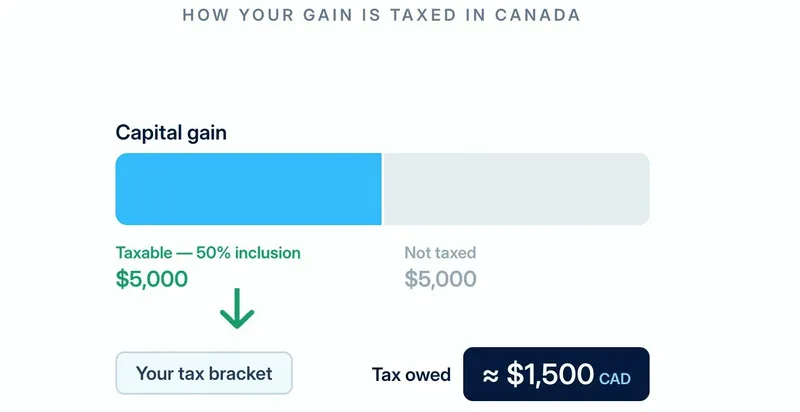
Canada taxes 50% of crypto capital gains and 100% of business income. How to calculate ACB, fill in Schedule 3 and T1135, and what CARF changes from 2027.