Ritual Review 2026: AI Layer 1, RITUAL Token and Key Risks
Ritual launched its AI-native Layer 1 and the RITUAL token on 26 October 2026, with 18% of 10 billion tokens circulating. Tech, tokenomics and risks.
Axis Robotics pays contributors in AXIS for robot training data on Base. We review its 7M trajectories, tokenomics, the October 2026 sell-off and user feedback.

By Mikko Mikailov6 min read
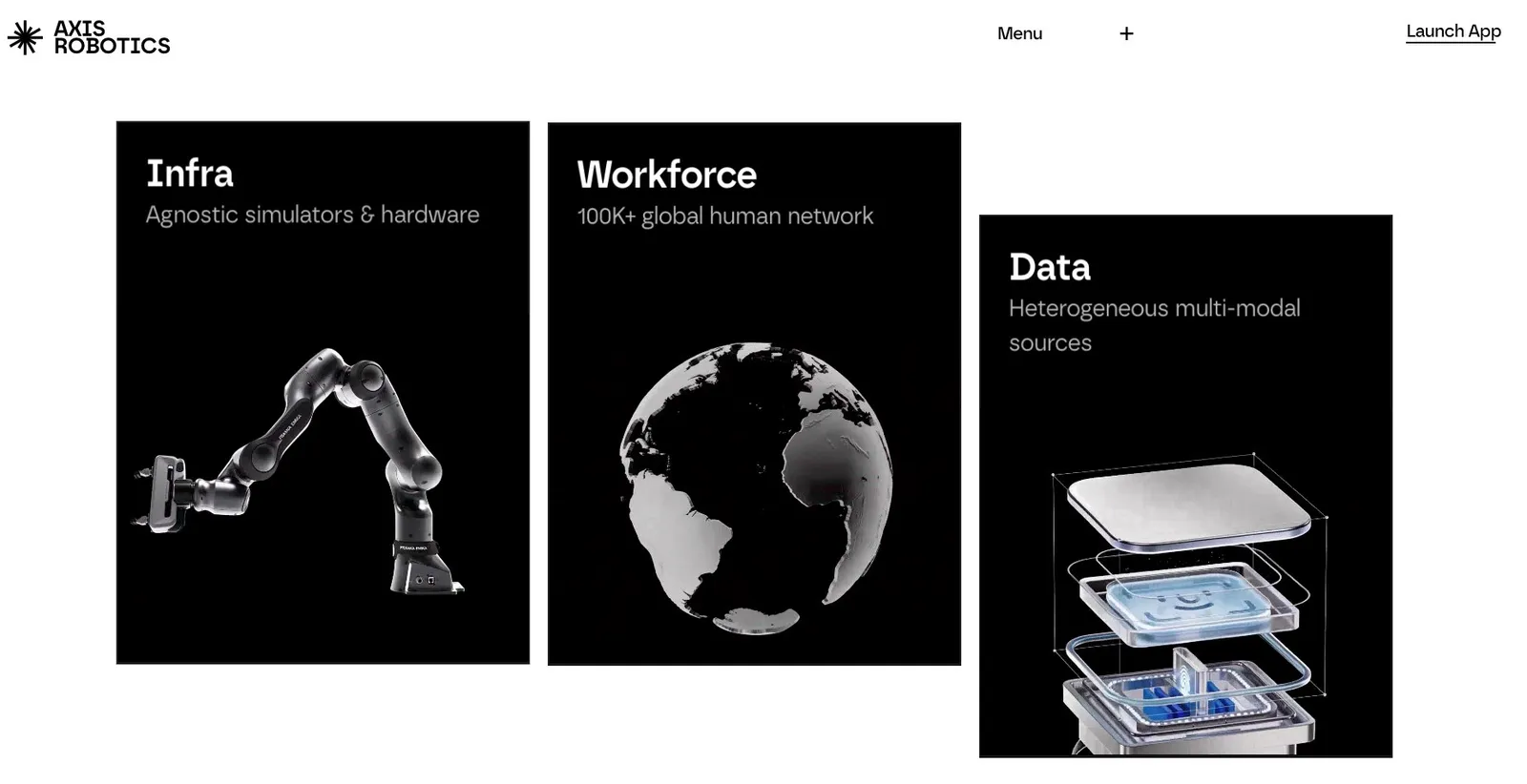
Axis Robotics is a crowdsourced data platform for physical AI: contributors steer simulated robot arms in a browser, and the resulting trajectories train robot models, with each accepted contribution recorded on Base. Its AXIS token began trading on 21 October 2026 and fell 40% on 29 October after investigator ZachXBT alleged insider selling, a claim the project denies. On 2 November 2026 AXIS traded at $0.1248 on CoinMarketCap, 25% above its $0.10 community sale price and 66% below its launch-week high of $0.3702.
Product maturity
3.2/5
3.2Axis Hub has run since January 2026 and produced 7M trajectories, but paying customers are not disclosed.
Risk profile
2.3/5
2.3An unresolved dispute over 42M AXIS sold on 29 October and 98.83% of supply in 10 wallets.
Our assessment
Axis Robotics runs a working data platform with 200,000+ contributors and a peer-reviewable research result, which puts it ahead of token-first projects that launch with nothing to show. The token side is weaker: a disputed sell-off eight days after launch, supply concentrated in a few wallets, and no published audit or revenue figures.
What stands out
What holds it back
Key facts
Language models scaled on text the internet had already written. Robots have no such corpus. Collecting physical demonstrations with real robots in a lab is slow and expensive, and Axis Robotics was built on the bet that a crowd with browsers is cheaper.
The pipeline, as described in the project's documentation and technical report:
The volume is real. Axis reported 1 million trajectories on 7 June 2026, 3 million by 13 August and more than 6 million by 2 October. Crypto Briefing put the total at 5.5 to 7 million from more than 200,000 contributors at launch.
Quality is the harder question, and here Axis offers one documented answer. In an arXiv paper (2607.21588), further pre-training Physical Intelligence's π0.5 model on Axis data raised its LIBERO-Plus success rate from 83.9% to 88.8%, 31.3 points above a control trained on the same amount of RoboCasa365 data. Axis also names Booster Robotics and Geely Auto as commercial partners. It has not disclosed contract values.
The co-founder and CEO is Jingze (Chris) Feng, and Dealroom lists Christine Cao as co-founder. Axis says its team includes researchers from UC Berkeley, Carnegie Mellon, UCLA and Nanyang Technological University. PitchBook counts 11 employees.
Location records disagree. PitchBook places the company in San Francisco, CB Insights in Berkeley, and CoinMarketCap describes a Singapore-based team. We found no corporate filing that settles it.
The funding record:
AXIS is an ERC-20 on Base with a fixed supply of 1 billion tokens and no inflation. 165 million, or 16.5%, circulated at launch. The full supply is released by T+35, 35 months after the token generation event.
The published allocation:
| Allocation | AXIS | Share | Release |
|---|---|---|---|
| Ecosystem | 510,833,333 | 51.08% | 80M at launch, then monthly to T+35 |
| Core team | 152,000,000 | 15.20% | 12-month cliff, then 24 months |
| Contributor rewards | 100,000,000 | 10.00% | Airdrop seasons 1 and 2 |
| Private A | 98,000,000 | 9.80% | 12-month cliff, then 24 months |
| Private B | 66,666,667 | 6.67% | 12-month cliff, then 24 months |
| Liquidity | 60,000,000 | 6.00% | Fully available at launch |
| Sonar sale | 10,000,000 | 1.00% | Monthly from T+6 to T+11 |
| Kaito reward pool | 2,500,000 | 0.25% | Fully available at launch |
The Ecosystem line matters more than the team line in year one. By our calculation from the published schedule, it releases 11.84 million AXIS a month, plus an extra 8.25 million at T+1 and at T+2. That is new supply every month equal to 7% of the launch float, before any team or investor tokens move in October 2027.
Token utility today is contributor rewards and ecosystem funding. Staking for access to higher-value tasks and governance are listed as proposals. Their terms have not been published.
Eight days after trading began, the market saw what a thin float does under pressure.
On 29 October 2026 ZachXBT alleged that addresses linked to Axis Robotics insiders received more than 76 million AXIS, worth over $12 million, from a team multisig, then sold through decentralized exchanges on Base and moved part to Bitget. He said one recipient sold 42 million AXIS for 5.04 million USDC across eight wallets. AXIS fell 35.9% in 24 hours to $0.1379 (CoinGecko, via The Crypto Times).
Axis Robotics responded within hours with a different account:
Axis says it cut ties with the counterparty and engaged lawyers. It has not named the firm. ZachXBT's findings are allegations, and Axis's explanation is a claim. No regulator, court or exchange has made a finding either way as of 2 November 2026.
In our interpretation, both accounts point to the same structural fact. Tokens counted as circulating sat in wallets that one party controlled and moved in bulk. A BaseScan snapshot on 29 October showed 8,173 holders, with the top 10 wallets holding 98.83% of total supply, a figure that includes the vesting contract. A sale of 42 million tokens equals 25% of the launch float. The chart did the rest.
Axis has no Trustpilot profile or app store listing to aggregate, so feedback comes from contributor guides, exchange research pages and social channels. The patterns repeat across sources.
Praise centers on access:
Complaints center on the token:
There is no price forecast here, by design. These are the dated events and open questions the project's future turns on:
The thesis is coherent. Robot learning does need data, and Axis has shown that it collects it at scale. Whether buyers pay for that data, and whether the token gets a role beyond paying for it, is still open.
AXIS trades on Coinbase in supported regions, which Coinbase has not listed. On platforms registered in Canada, CSA terms cap net purchases of non-exempt tokens such as AXIS at $30,000 over 12 months for retail investors who are not eligible or accredited. Canadian tax practitioners treat airdropped AXIS as income at fair market value on receipt, and the CRA treats each later sale as a disposition measured in CAD.

Mikko has been writing about money since 2015, covering payment services, trading platforms and crypto for readers in several markets. He leads exchange and wallet reviews at CryptoInfoBase.
Ritual launched its AI-native Layer 1 and the RITUAL token on 26 October 2026, with 18% of 10 billion tokens circulating. Tech, tokenomics and risks.
Ash Crypto (@AshCrypto) has 2.1 million X followers. We check his bio, the net worth claims, his public market calls and the May 2026 ZachXBT allegations.
Binance customers pulled a net $4.72 billion after withdrawals reopened on 1 November 2026. What happened, who the FBI blames, and why bitcoin held at $78,000.