Ash Crypto Net Worth 2026: Bio, Track Record and Allegations
Ash Crypto (@AshCrypto) has 2.1 million X followers. We check his bio, the net worth claims, his public market calls and the May 2026 ZachXBT allegations.
Uniswap Wallet charges 0% interface fees since December 2025 and holds 4.67 stars on Google Play. We check key storage, open source code, networks and reviews.

By Mikko Mikailov6 min read
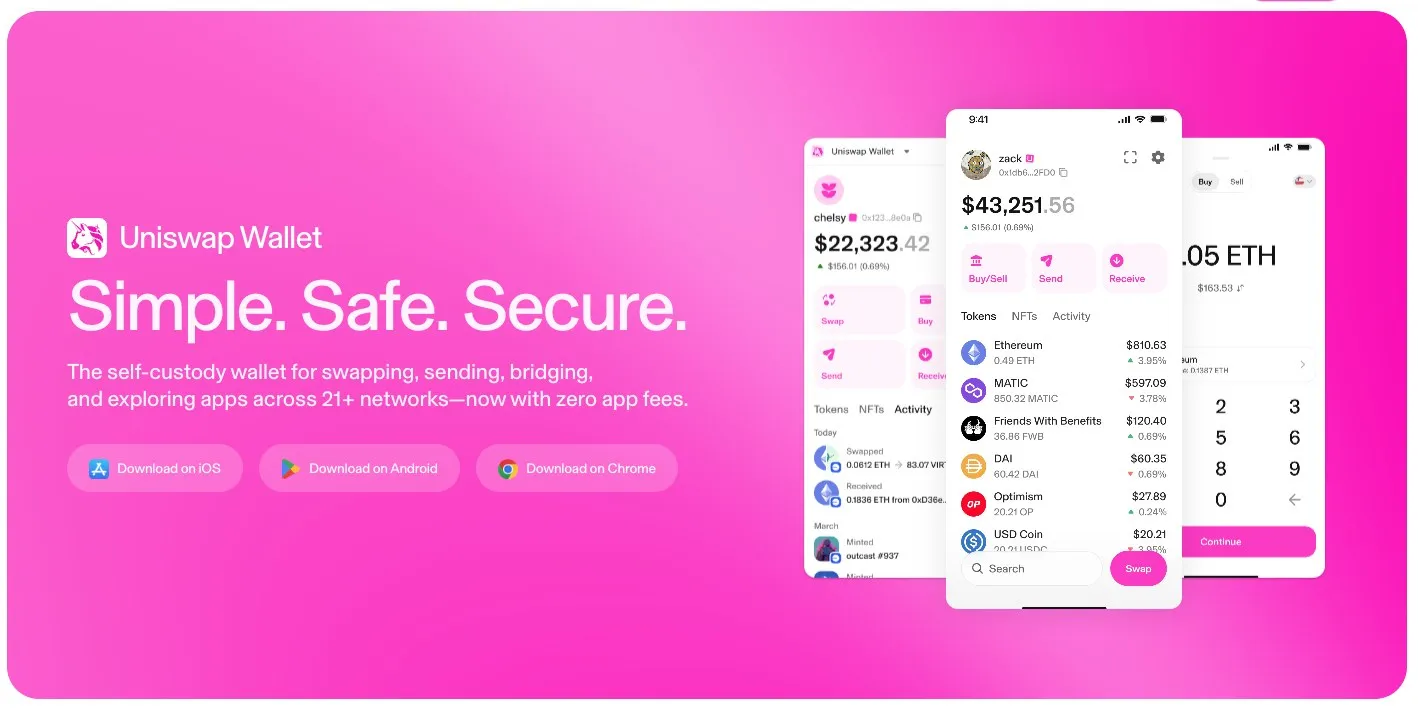
Uniswap Wallet is a free, self-custody mobile wallet and browser extension from Uniswap Labs, built for swapping tokens on Ethereum and 20 other EVM networks. Since 27 December 2025 it charges no interface fee on swaps, its source code is public under GPL-3.0, and the Android app holds 4.67 stars from 21,318 ratings. The trade-off is scope. It does not hold Bitcoin, its Solana support is partial, and it has no staking.
4.2/5
4.2Our assessment
Our verdict
Uniswap Wallet is a self-custody wallet built for one task, swapping tokens on EVM networks, and it does that task with no interface fee, open source code and an audited codebase. Its limits sit in coverage: no Bitcoin, partial Solana support and no native staking.
Score breakdown
What stands out
What holds it back
Uniswap Wallet is non-custodial. Uniswap Labs never holds a copy of the recovery phrase or the private keys, and creating a wallet needs no account, email or ID.
The key-handling model, as described in the App Store listing and Uniswap's documentation:
Recovery follows from that model. A user restores the wallet on a new device by entering the recovery phrase or by decrypting the iCloud backup with its password. If both are lost, nobody restores access, Uniswap Labs included. That is the price of self-custody, and the app does not hide it.
Since the Ethereum Pectra upgrade, the wallet offers optional smart wallet features through EIP-7702 delegation. The user's existing address points to Calibur, a contract implementation from Uniswap that enables batched transactions, such as an approval and a swap in a single step. The address and its on-chain history stay the same. Uniswap's documentation states that Calibur is deployed to one address across networks, is non-upgradeable and has no owner.
Delegation is a broad permission, and EIP-7702 has drawn phishing attempts across the industry in 2026. The risk sits in signing a delegation to an attacker's contract, not in Calibur itself.
The wallet's code is public. The Uniswap/interface repository on GitHub holds the web app, the mobile wallet and the extension under a GPL-3.0 licence, and every production release is tagged there. The App Store listing states that the wallet's source code was audited by Trail of Bits.
The security record of the wallet apps themselves is clean. We found no reported exploit of Uniswap Wallet or the Uniswap Extension leading to user losses. The closest incident on record involved the protocol, not the wallet:
In our interpretation, the larger risk for users lies outside the code. Fake Uniswap sites and impersonating apps target the brand, and a self-custody wallet offers no chargeback once a malicious approval is signed.
The interface fee history explains the current price. Uniswap Labs introduced a 0.15% fee on certain swaps in its web app and wallet on 17 October 2023, later raised it to 0.25%, and set it to zero on 27 December 2025 after UNI holders approved the UNIfication proposal. Uniswap's own support page lists the Labs interface and wallet fee at 0%.
What remains on each swap:
| Cost | Amount | Who receives it |
|---|---|---|
| Uniswap Labs interface fee | 0% | Not charged |
| Liquidity pool fee | 0.01% to 1% by pool tier (v3), flexible in v4 | Liquidity providers, with a protocol share on selected pools |
| Network gas | Set by the network | Validators |
| Card or bank purchase | Set by the third-party provider | The provider |
A $1,000 swap of ETH for USDC through a 0.05% pool costs $0.50 in pool fees plus gas. On Base or Arbitrum gas runs to cents. On Ethereum mainnet it varies with congestion. Card purchases are where costs rise. Reviewers report third-party on-ramp fees of 3% to 5% built into the quoted rate, and the app shows the provider's price before confirmation.
Uniswap's support center lists ERC-20 support on 22 networks, including Ethereum, Base, Arbitrum, Optimism, Polygon, BNB Smart Chain, Avalanche, Unichain, ZKsync and Solana. Its separate networks table still marks Solana as available in the Uniswap web app only. In practice, Solana support in the wallet is partial and evolving, and EVM networks are the core of the product. All EVM networks share one address.
Features inside the app:
Features it lacks: native staking, liquidity provision management inside the app, Bitcoin and other non-EVM assets, and in-app two-factor authentication beyond the device lock.
User sentiment splits sharply by platform. The app stores show a well-regarded product:
Trustpilot tells another story. The profile for app.uniswap.org holds 1.3 stars from 887 reviews, 96.51% of them one-star, with the latest review dated 17 July 2026 (Traders Union).
The negative reviews follow recurring patterns:
Read together, the numbers make sense. People who use the wallet rate the wallet. People who lost money, often to someone else's site, rate the brand. Neither score alone describes the product. The Trustpilot complaints are allegations from individual users, and we found no finding by a regulator or court against Uniswap Wallet.
For Canadian users the wallet works as it does elsewhere. It needs no account, no KYC for the wallet itself, and no Canadian registration, since it never holds client assets. In our interpretation, that is also why it sits outside the CSA regime for crypto trading platforms, which targets firms that take custody.
Two Canadian specifics deserve attention:
The wallet suits Canadians who already hold ETH or stablecoins and want low-cost swaps on Layer 2 networks. Those who need Bitcoin storage, staking or a regulated on-ramp in one place will need a second tool.

Mikko has been writing about money since 2015, covering payment services, trading platforms and crypto for readers in several markets. He leads exchange and wallet reviews at CryptoInfoBase.
Ash Crypto (@AshCrypto) has 2.1 million X followers. We check his bio, the net worth claims, his public market calls and the May 2026 ZachXBT allegations.
Axis Robotics pays contributors in AXIS for robot training data on Base. We review its 7M trajectories, tokenomics, the October 2026 sell-off and user feedback.
Binance customers pulled a net $4.72 billion after withdrawals reopened on 1 November 2026. What happened, who the FBI blames, and why bitcoin held at $78,000.