BingX Reviews 2026: Security Record, Fees and User Complaints
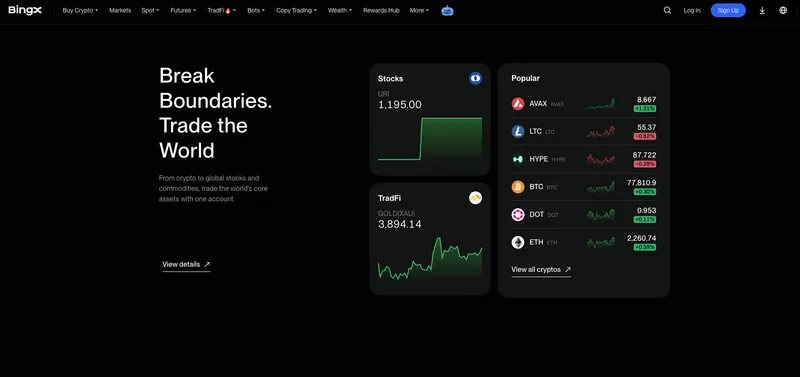
BingX charges 0.10% on spot and 0.02%/0.05% on perpetuals. We checked its 2024 hack, proof of reserves, licenses and 766 Trustpilot reviews.
3.7Bitget charges 0.10% on spot trades but lists Canada as a prohibited country. We review its fees, the $387.5M hack, reserves and 1,701 Trustpilot reviews.

By Mikko Mikailov6 min read
Bitget is a Seychelles-based exchange with 125 million registered users, 0.10% base spot fees and 3,323 spot assets, but it is not open to Canadian residents. Its Terms of Use name Canada as a prohibited country, its Canadian FINTRAC registration lapsed on 31 March 2023, and the Alberta Securities Commission lists it on its Investment Caution List. On its home turf the record is mixed: a $387.5 million hack in September 2026 cost users nothing, while Trustpilot sits at 1.7.
3.9/5
3.9Offshore derivatives platform
Our verdict
Bitget pairs low base fees and 3,323 spot assets with monthly proof of reserves and a Protection Fund that covered a $387.5 million hack in September 2026. For Canadian readers the review is mostly academic. Bitget lists Canada as a prohibited country and holds no Canadian registration.
Score breakdown
What stands out
What holds it back
Key facts
For a Canadian reader this section decides the rest. Bitget was never registered with Canadian securities regulators. The FINTRAC money services business registration of Canada Bitget Limited (M20179708) expired on 31 March 2023, according to the FINTRAC registry as cited by OCryptoCanada. On 1 April 2024 the Alberta Securities Commission placed Bitget on its Investment Caution List, stating it was not registered to trade or advise on securities or derivatives in Alberta. Saskatchewan's FCAA published a similar caution through the CSA.
The exit itself came in stages. Reports from Canadian users describe a notice sent to Canadian IP addresses on 12 January 2026, after which new Canadian KYC stopped, CAD funding was switched off, Earn positions were removed and open trades moved to reduce-only. A later notice set 31 August 2026 as the final date for Canadian account access. Both timelines come from secondary outlets. What the primary record shows is simpler. As of October 2026, Bitget's terms list Canada among prohibited countries and its site states that it does not operate a financial services business in Canada.
In our interpretation, Bitget chose not to pursue the restricted dealer route that Kraken, Coinbase, Netcoins and Newton completed. That route requires a pre-registration undertaking with the CSA and limits on altcoin purchases and leverage, which sit poorly with a business built on 125x futures. Bitget is not on the CSA list of banned platforms. It simply left.
Outside Canada, Bitget's pricing is competitive at the base tier. The table uses Bitget's own fee FAQ of 20 August 2026 and withdrawal data read on 20 October 2026.
| Item | Fee |
|---|---|
| Spot trading | 0.10% maker / 0.10% taker |
| Spot with BGB fee payment | 0.08% (20% discount) |
| USDT-M perpetual futures | 0.02% maker / 0.06% taker |
| Instant buy (card, third-party) | Set by the provider and shown at checkout |
| Crypto deposits | Free |
| USDT withdrawal, BEP20 | 0.01 USDT |
| USDT withdrawal, TRC20 | 1 USDT |
| BTC and ETH withdrawal | Network-dependent, shown on the withdrawal screen |
A $1,000 spot purchase of BTC costs $1.00 in taker fees, or $0.80 when paid in BGB. Selling it back costs the same again. Futures change the math. A $1,000 margin position at 10x leverage opens $10,000 of notional exposure, so the taker fee is $6.00 to open and $6.00 to close, before funding payments. At the top VIP tier, which requires $500 million in monthly volume, futures fees fall to 0% maker and 0.01% taker.
Bitget has published a proof of reserves report every month since December 2022. The August 2026 report, its 45th, showed a total reserve ratio of 122% and expanded coverage from 4 assets to more than 20. Users verify inclusion through a Merkle tree tool published on GitHub. A reserve snapshot is not an audit, and Bitget's own release says so.
Behind the reserves sits the Protection Fund, backed by 5,500 BTC with a stated floor of $300 million. Its August 2026 valuation averaged $382 million.
That fund was tested within weeks. On 24 September 2026 attackers moved $387.5 million out of Bitget's hot and warm wallets across multiple blockchains. The first estimate was $351.6 million. Forensic reviews by Mandiant and SlowMist found that the attackers used zero-day exploits in two third-party security appliances, moved to the production wallet job server, and sent spoofed withdrawal requests that Bitget's own systems signed (BleepingComputer). Private keys were not stolen and cold wallets were not touched, according to CEO Gracy Chen. Blockchain analytics firm Elliptic linked the attack to North Korea with high confidence. No court or government has confirmed that attribution.
The response was fast by industry standards. Bitget published a phased schedule and kept it:
The Protection Fund absorbed the loss and was back at $309 million on 30 September (Cointelegraph). Customers pulled $463 million net in a single day as withdrawals restarted (Bloomberg Government). Nobody lost a balance. Still, an exchange that signs whatever its compromised middleware tells it to sign has a problem that a fund only pays for after the fact.
The hack was not the only event of 2026. These are the dated incidents on the record:
Bitget handled both through compensation plans. Both were also decided case by case, under its own terms.
Bitget holds registrations rather than full licences in its markets. The list as of 2026:
Bitget withdrew from France in March 2026 and is closing Japanese accounts by 31 December 2026. The United States, Canada, Singapore, Hong Kong, Germany and Austria are on its restricted list.
User sentiment splits by platform. On 23 October 2026 Trustpilot showed a TrustScore of 1.7, labeled "Bad", from 1,701 reviews (Tradelize). 75% gave one star and 12% gave five. Bitget replied to 84% of negative reviews. The app stores tell a different story: 4.6 on iOS from 5.6K ratings and 4.6 on Android from 324K reviews.
Recurring complaint themes across 2026 reviews:
Recurring praise:
Trustpilot skews toward users with a dispute. Even so, a gap of three points between the app stores and Trustpilot says the trading engine works and the escalation path often does not.
Bitget suits traders in permitted jurisdictions who want futures, copy trading and long-tail altcoins at base fees of 0.10% and below. It also suits users who weigh monthly reserve disclosure and a track record of covering losses.
It does not suit Canadian residents in any province. Canadians who need a registered platform have four nationally registered restricted dealers to compare: Kraken, Coinbase, Netcoins and Newton. Legacy Canadian users with balances left on Bitget are limited to withdrawals to a private wallet. Opening positions is no longer possible.

Mikko has been writing about money since 2015, covering payment services, trading platforms and crypto for readers in several markets. He leads exchange and wallet reviews at CryptoInfoBase.
BingX charges 0.10% on spot and 0.02%/0.05% on perpetuals. We checked its 2024 hack, proof of reserves, licenses and 766 Trustpilot reviews.
3.7Ash Crypto (@AshCrypto) has 2.1 million X followers. We check his bio, the net worth claims, his public market calls and the May 2026 ZachXBT allegations.
Axis Robotics pays contributors in AXIS for robot training data on Base. We review its 7M trajectories, tokenomics, the October 2026 sell-off and user feedback.