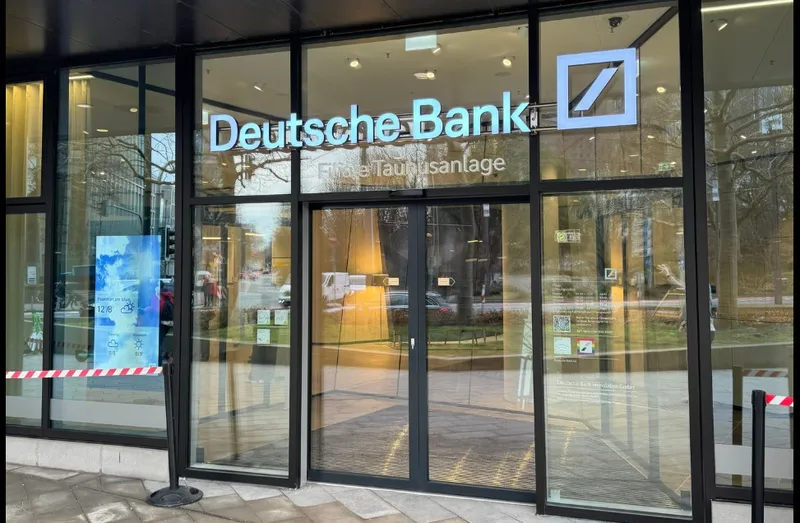
Deutsche Bank Launches Crypto Custody for Institutions
Deutsche Bank launched crypto custody on 11 November 2026 for corporate and institutional clients. It holds Bitcoin, Ether, USDC, EURC and EURAU.
Goldman Sachs, Citi and 19 other financial firms back a reported $270M stablecoin venture. Project Faro targets a 2027 launch, with a euro token planned.

By Mikko Mikailov4 min read
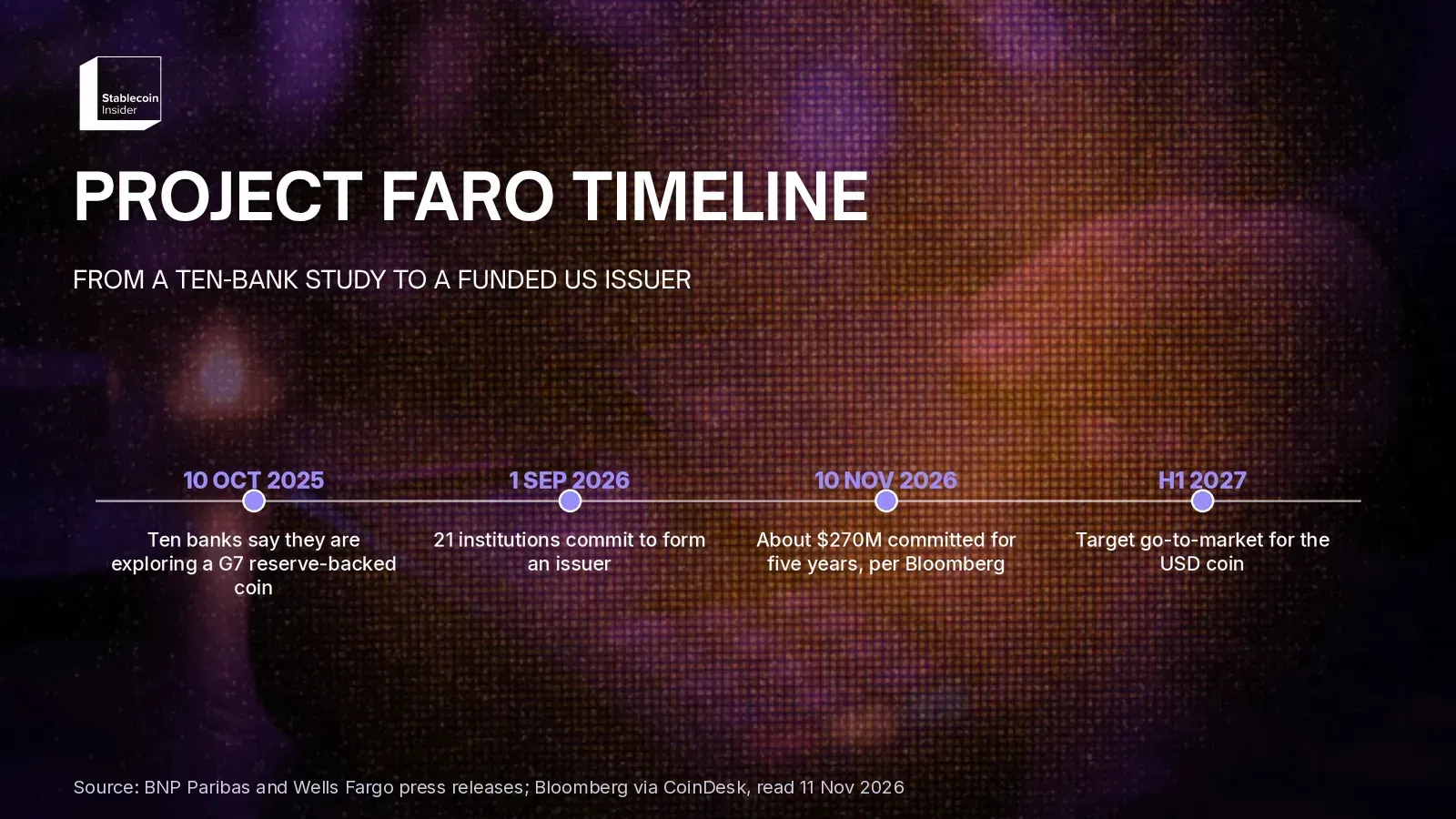
Goldman Sachs, Citigroup, Santander and Deutsche Bank are among 21 financial institutions backing a joint stablecoin venture with a reported $270 million funding commitment, according to Bloomberg on November 10, 2026. The money is intended to cover five years of operating expenses for a new US-based issuer operating under the working name Project Faro. Its first product will be a dollar-pegged stablecoin, with a commercial launch targeted for the first half of 2027.
The consortium confirmed its plans to establish the company on September 1, but did not disclose a funding amount. The $270 million figure comes from people familiar with the arrangements rather than a public financial statement.
Project Faro brings together 21 financial institutions from five geographic regions. The group started with ten banks exploring blockchain-based digital money in October 2025. By September 2026, it had expanded to include investment managers and banks with established payment operations across multiple markets.
Its participants include:
The venture intends to issue a stablecoin pegged to the US dollar. Unlike Bitcoin, whose price changes with market demand, a fiat-backed stablecoin is designed to maintain a fixed value against its reference currency through reserves and redemption arrangements.
The banks have identified cross-border payments and digital asset settlement as initial applications. Their announcement also covers institutional and retail markets, although it does not specify how individuals would access the token.
A euro-denominated stablecoin is next on the agenda. The consortium eventually wants to support additional G7 currencies, but no issuance dates have been published beyond the initial dollar launch.
The reported $270 million is intended to fund the issuer's operating expenses over five years. It is not the amount of dollar reserves backing the future stablecoin and does not represent the value of tokens scheduled for issuance.
That distinction matters. A stablecoin issuer needs separate reserve assets to support outstanding tokens and meet redemption requests. Its operating budget pays for running the business.
Project Faro has yet to publish several details that determine how the product will function:
The consortium has stated that it intends to operate under the US GENIUS Act and the European Union's Markets in Crypto-Assets Regulation (MiCA), where applicable.
The GENIUS Act, signed into law on July 18, 2025, established a federal framework for payment stablecoins. Its requirements include eligible reserve backing and public disclosures. MiCA provides a separate regulatory framework for crypto-assets in the European Union.
The planned regulatory approach is public. Actual authorization, reserve arrangements and operational compliance remain separate questions.
Tether and Circle already operate the two leading dollar stablecoins, USDT and USDC. Their position rests on existing circulation, exchange integrations and use across crypto trading and payment services.
Project Faro enters this market with a different distribution model. Its backers already serve corporate clients, payment businesses, institutional investors and consumers through conventional financial infrastructure. A shared digital currency would allow participating institutions to settle eligible transactions using the same token rather than relying on separate bank-issued assets.
The consortium's business logic is understandable. Banks already handle the customer relationships, compliance procedures and payment instructions. The missing component is a common digital settlement asset that can move across participating institutions and supported blockchain networks.
But established banking relationships do not automatically create stablecoin liquidity.
A token used inside a consortium has limited reach if exchanges, custodians, payment processors and outside financial institutions do not support it. The banks also need to agree on governance, reserve management and redemption arrangements. With 21 participating institutions, those decisions involve competing commercial interests.
There is another distinction between Project Faro and crypto-native issuers. A bank consortium has an existing client network through which it can distribute a token. Whether it can match the availability and interoperability of USDT and USDC depends on the product's eventual design, not the number of institutions behind it.
The $270 million commitment gives the project a funded operating plan, according to Bloomberg's sources. It does not establish future circulation, transaction volume or market share.
The proposed launch in the first half of 2027 is therefore the next concrete milestone. As of November 12, 2026, Project Faro has no publicly launched stablecoin, disclosed reserve portfolio or operating transaction history. The banks have agreed on the direction. The product still has to prove that a shared banking network can function as a common digital currency system.

Mikko has been writing about money since 2015, covering payment services, trading platforms and crypto for readers in several markets. He leads exchange and wallet reviews at CryptoInfoBase.
Deutsche Bank launched crypto custody on 11 November 2026 for corporate and institutional clients. It holds Bitcoin, Ether, USDC, EURC and EURAU.
Visa added Monad to its stablecoin settlement program on 10 November 2026. The program ran at a $25 billion annualized rate as of 27 October 2026.
The OCC gave final approval to Coinbase National Trust Company on 6 November 2026. What the charter allows, the $60M capital rule and the lawsuit over it.