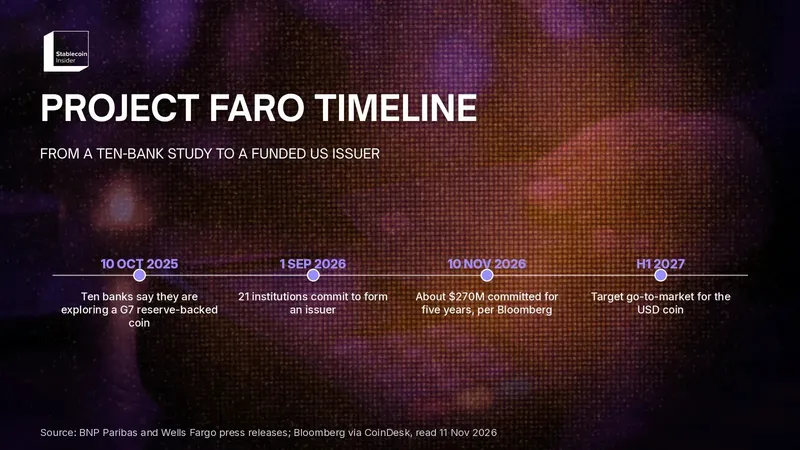
Goldman Sachs, Citi Back $270M Joint Stablecoin Venture
Goldman Sachs, Citi and 19 other financial firms back a reported $270M stablecoin venture. Project Faro targets a 2027 launch, with a euro token planned.
Binance restored withdrawals on 87 networks after its $6.3 billion hack. Its November 14 update sets a new deadline, but some withdrawal routes remain closed.

By Mikko Mikailov4 min read
Binance said on November 14, 2026, that it had reopened cryptocurrency withdrawals across 87 blockchain networks during the week and was targeting the end of the following week to restore the remaining networks and assets. The announcement comes after hackers stole $6.3 billion from the exchange on October 29. Binance says it has already replaced the affected assets, but that is a different milestone from making every withdrawal route available again.
Binance's November 14 notice lists 87 networks for which withdrawals resumed during the week. They include:
The count refers to networks reopened during the week, not the total number of supported networks or a confirmation that every token is available on every network. Binance still directs customers to the withdrawal page for the selected asset and network. It also warns of processing delays while services return.
The exchange said it aims to reopen the remaining routes by the end of next week. That is a target, not an announcement that full service has returned. Its notice gives no separate timetable for each unsupported asset or network.
This is an operational distinction with consequences. A customer may see a balance on the exchange while the specific blockchain route needed to transfer that asset remains unavailable. Binance has progressively restored services since November 1, but an open trading interface and a functioning withdrawal route are not the same thing.
Two days before the withdrawal update, Binance announced that it had completed coverage of the assets affected by the breach. The company said it committed more than $6.34 billion to acquire replacement tokens through exchanges and over-the-counter markets. It identified three funding sources:
Binance also said it intends to restore SAFU to a value of $1 billion. It did not publish a completion date for that replenishment in the November 12 notice.
The exchange released a new Proof of Reserves snapshot taken at 00:00 UTC on November 12, covering 198 tokens. Binance said holders of affected assets would be able to verify backing of at least 1:1 after the snapshot's zero-knowledge proof was generated. The company estimated that computation would take 40 to 50 hours. The snapshot is evidence of reported reserve backing at a point in time. It does not establish that the intrusion has been fully explained or that every transfer route is operating.
These are the different stages Binance and law enforcement have described as of November 14:
| Issue | Reported status | Limit of the update |
|---|---|---|
| Withdrawal access | 87 networks reopened during the week ending November 14 | Other routes remain pending |
| Affected asset coverage | Binance declared coverage complete on November 12 | Replacing customer assets is not the same as recovering stolen coins |
| Proof of Reserves | November 12 snapshot covers 198 tokens | The snapshot does not verify the security of wallet infrastructure |
| Stolen asset restraint | More than $2.7 billion frozen through public and private efforts, according to US authorities on November 12 | A freeze is not a final forfeiture or return of funds |
The balance-sheet repair and the withdrawal recovery are moving on different schedules. The first is what Binance says it has funded. The second is still being rolled out.
On November 12, the US Department of Justice said cooperation between government agencies and private companies had frozen more than $2.7 billion of the stolen cryptocurrency. Courts had authorized the seizure or restraint of more than $1.2 billion within that effort. The $1.2 billion is part of the broader $2.7 billion figure, not an additional amount to add to it.
The DOJ said efforts to trace and recover the assets were continuing. Freezing tokens prevents or restricts transfers under the relevant controls. Seizure, forfeiture and eventual distribution involve further legal steps. None should be confused with Binance using its own resources to replace affected balances.
The FBI attributed the October 29 attack to a North Korean operation it calls TraderTraitor. The bureau reported that the actors had been converting stolen assets into Ether and warned that laundering through DeFi and instant-swap services could follow. North Korea denies responsibility, according to Reuters.
Binance's preliminary account described a campaign that began months before the theft, combining compromised developer machines and unauthorized access to wallet-signing infrastructure. We covered the technical sequence in our November 3 report on the Binance hack. The new withdrawal announcement does not add a final technical explanation or independent findings about the security changes made since the breach.
The central unknown is no longer whether Binance has announced enough funds to replace the stolen assets. It is how and when the platform will finish restoring access, and what independent evidence will establish that the underlying failure has been addressed.
As of November 14, the outstanding questions are straightforward:
Binance's November 14 statement answers the first stage of the operational question by confirming 87 network reopenings. It does not answer the rest. The practical test of the recovery is whether the final unsupported routes come back and remain accessible without another suspension.

Mikko has been writing about money since 2015, covering payment services, trading platforms and crypto for readers in several markets. He leads exchange and wallet reviews at CryptoInfoBase.
Goldman Sachs, Citi and 19 other financial firms back a reported $270M stablecoin venture. Project Faro targets a 2027 launch, with a euro token planned.
Deutsche Bank launched crypto custody on 11 November 2026 for corporate and institutional clients. It holds Bitcoin, Ether, USDC, EURC and EURAU.
Visa added Monad to its stablecoin settlement program on 10 November 2026. The program ran at a $25 billion annualized rate as of 27 October 2026.