Visa Adds Monad to Stablecoin Settlement Program
Visa added Monad to its stablecoin settlement program on 10 November 2026. The program ran at a $25 billion annualized rate as of 27 October 2026.
Deutsche Bank launched crypto custody on 11 November 2026 for corporate and institutional clients. It holds Bitcoin, Ether, USDC, EURC and EURAU.

By Mikko Mikailov3 min read
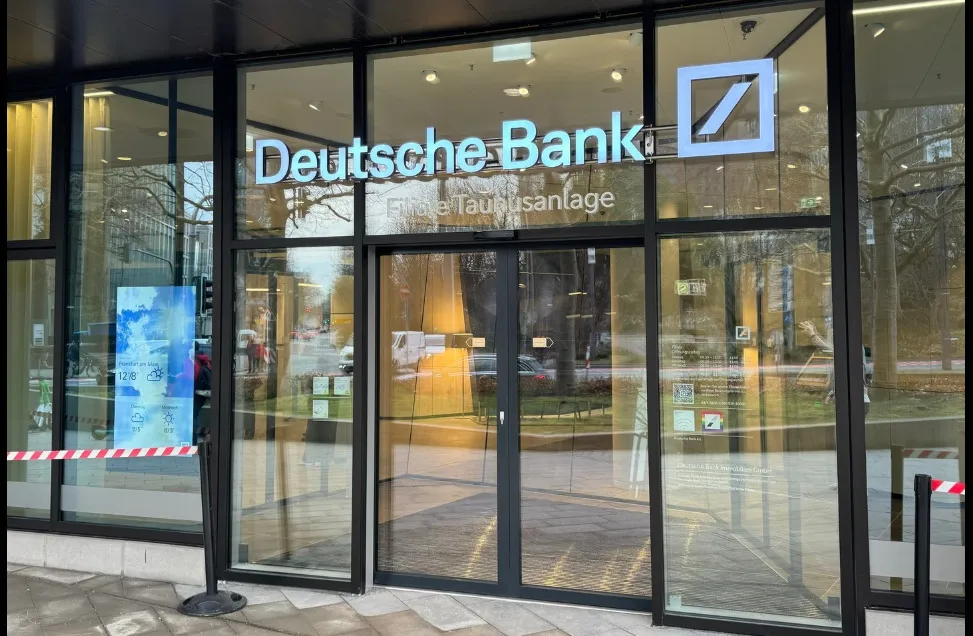
Deutsche Bank launched its crypto custody service for corporate and institutional clients on 11 November 2026, with Germany as the first market. The bank holds Bitcoin, Ether and three stablecoins (USDC, EURC and EURAU) and manages the clients' private keys. The service runs under the EU's Markets in Crypto-Assets Regulation (MiCA), and the bank's register listing dated 12 October 2026 names BaFin as regulator. The bank has not disclosed a client count or the assets under custody.
Custody means a firm keeps an asset safe on behalf of a client. A crypto-asset is controlled by a private key, the secret code that authorizes every transfer, and whoever holds the key controls the asset. In Deutsche Bank's service the bank manages the wallets and keys for the client, which makes the model custodial. Self-custody is the opposite arrangement, where the holder keeps the key.
According to coverage of the bank's product page, the platform handles custody, transfers to third parties and internal transfers between storage environments. Keys sit in hardware-protected storage, assets sit in warm and cold wallets, transactions need multiple approvals and client assets are held separately. A warm wallet stays connected for faster transfers, while a cold wallet stays offline. Clients reach the service through Autobahn, the bank's corporate banking platform.
Five assets are supported at launch.
| Asset | Type | Issuer | Pegged to |
|---|---|---|---|
| Bitcoin (BTC) | Cryptocurrency | None | None |
| Ether (ETH) | Cryptocurrency | None | None |
| USDC | Stablecoin | Circle | US dollar |
| EURC | Stablecoin | Circle | Euro |
| EURAU | Stablecoin | AllUnity | Euro |
The service targets eligible institutional and corporate clients and not retail investors. The 16 September announcement named six client groups.
MiCA is the EU regulation that sets licensing and conduct rules for firms holding and transferring crypto-assets for clients. BaFin is Germany's financial supervisor. Deutsche Bank's MiCA register entry for crypto custody and transfer services is dated 12 October 2026 and names BaFin.
| Date | Event |
|---|---|
| 2023 | Deutsche Bank partners with Taurus on custody technology after applying for a German digital asset custody license |
| 16 September 2026 | The bank announces the service, pending regulatory clearance |
| 12 October 2026 | MiCA register entry dated, with BaFin named as regulator |
| October 2026 | Gerald Podobnik, co-head of the corporate bank, tells Reuters the launch comes first in Germany, with Asian financial centers following in 2027 |
| 11 November 2026 | The service goes live |
CoinCentral reports that the bank lists Germany as the initial market, with cross-border servicing in Europe subject to applicable rules. Other outlets describe the launch as Europe-wide, and we follow the bank's narrower wording. The bank also warns that crypto-assets lack deposit-guarantee protection comparable to eligible bank deposits.
The launch leaves four questions open.
Editorial view. The launch moves part of the institutional market from crypto-native custodians to a bank that already holds the client's accounts. That is a real change in who holds the keys. Until now a corporate treasury buying Bitcoin dealt with an exchange or a specialist custodian, and now it deals with one relationship that sits under MiCA and a national supervisor. The cost of that convenience is concentration. Cash, credit and crypto-assets sit with one counterparty, and the crypto part carries no deposit guarantee.
The stablecoin list says something too. Two of the three tokens are euro-denominated, which fits a European client base. EURAU has a tie to the bank group, since Cointelegraph calls AllUnity Deutsche Bank-backed and AllUnity names DWS, now branded Deutsche Asset Management, among its founding partners. That is a disclosure point and not a sign of wrongdoing, and the bank has not said whether it earns anything from the token.
Custody is also the narrowest crypto service a bank offers. It is not trading, not issuance and not an investment product. The direction is clear. The scale is not, because no client number exists yet. The same bank-meets-crypto pattern runs the other way in the US, where we covered Coinbase's national trust bank approval, and inside payment networks, as in Visa adding Monad to its stablecoin settlement program.

Mikko has been writing about money since 2015, covering payment services, trading platforms and crypto for readers in several markets. He leads exchange and wallet reviews at CryptoInfoBase.
Visa added Monad to its stablecoin settlement program on 10 November 2026. The program ran at a $25 billion annualized rate as of 27 October 2026.
The OCC gave final approval to Coinbase National Trust Company on 6 November 2026. What the charter allows, the $60M capital rule and the lawsuit over it.
FinCEN barred US financial institutions from moving funds to or from MEXC Global, citing $16 billion in illicit flows from May 2021 to May 2026.