Binance Hack: Fake Job Interview and AI Tool Behind $6.3B Theft
Binance's incident report shows how hackers used a fake job interview, malware and an internal AI tool to steal $6.3 billion. $5.28 billion left in 46 hours.
Bitcoin fell below $76,000 on 4 November 2026 as Democrats won both chambers of Congress, then rebounded above $78,000. What it means for the CLARITY Act.

By Mikko Mikailov4 min read
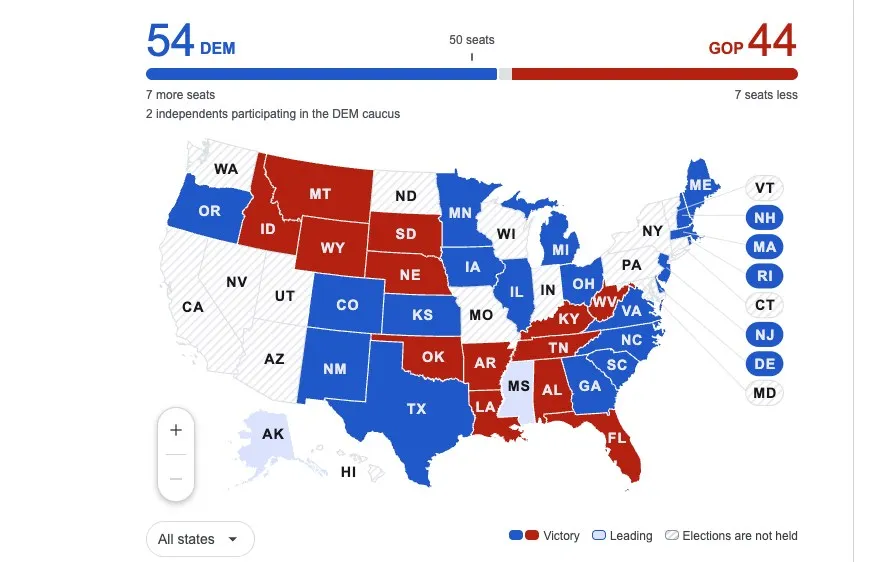
Bitcoin dropped just below $76,000 early on Wednesday, 4 November 2026, as reports showed Democrats winning control of both chambers of the US Congress in the 3 November midterm elections, then recovered above $78,000 within hours (CoinDesk). Reuters reported the dip alongside pressure from the 29 October Binance hack. The market move faded fast. The policy question did not: a Democratic Congress puts the Republican-backed CLARITY Act, the main US crypto market-structure bill, on hold until at least 2027.
The selloff came overnight in US hours and reversed within the same session. CoinDesk recorded these levels and flows:
| Metric | Figure | Source |
|---|---|---|
| Overnight low | Just below $76,000 | CoinDesk |
| Price at writing | $78,300, up nearly 1% on the day | CoinDesk |
| Election-day BTC options block trades | $660 million notional, more than double the prior day | CoinDesk |
| Calls bought vs. sold | $420 million vs. $105 million | CoinDesk |
| US spot Bitcoin ETF outflows, October 2026 | $515 million | SoSoValue via CoinDesk |
| US spot Bitcoin ETF outflows, 2-3 November | $515 million | SoSoValue via CoinDesk |
| Nasdaq futures | 28,200, down 0.3% after a fall of more than 2% | CoinDesk |
The result was not a surprise to traders. Polymarket priced a Democratic sweep at 62% on 10 October, and Paradigm's Nicolas Quatravaux told CoinDesk the platform had priced a Democratic win above 75% for a while. Analysts framed the dip as a reaction to uncertainty, not to the outcome itself. Dick Lo of TDX Strategies said a Democratic Congress is generally less favorable for pro-crypto legislation, and that the recovery came once results resolved the political question.
The demand side stayed weak. ETF redemptions continued into November, and negative Coinbase premium readings pointed to soft US buying. Vikram Subburaj of Giottus said a hold above $78,000 during ETF outflows would show buyers absorbing supply. Bitget Wallet's Lacie Zhang placed resistance at $80,000-$82,000.
The CLARITY Act was supposed to settle which US regulator oversees which digital assets. It never reached the finish line under Republican control. The Senate failed to advance it in September 2026, after Democratic objections that included the bill's lack of limits on President Trump's personal crypto holdings.
With both chambers changing hands in January, the bill's path narrows. Analysts tracking the process before the vote described what a sweep changes:
The industry spent heavily to avoid this outcome. Crypto-backed groups put $176 million into more than 100 races, per TD Cowen's note cited by Bitcoin Magazine. Stand With Crypto, the advocacy initiative launched by Coinbase, had warned lawmakers who blocked the bill in September of "consequences" at the polls.
What a Democratic Congress does not do matters too. It does not reverse existing agency rules or executive actions on its own. Those stay with the administration.
The election landed on a market still absorbing the largest crypto theft on record. On 29 October 2026, attackers moved $6.36 billion out of Binance wallets on ten blockchains, the bulk of it within 20 minutes, according to TRM Labs.
The known facts as of early November:
Bitcoin fell 3.2% below $79,000 on the evening of the hack (NBC). Shares of Coinbase dropped 4.8% and Strategy close to 6% in extended trading, per Reuters.
So the week stacked three pressures on one market. A record theft at the largest exchange. Continued ETF outflows. And a Congress that now owns the regulatory agenda for the next two years. Bitcoin held $78,000 through all of it, as of Wednesday morning.

Mikko has been writing about money since 2015, covering payment services, trading platforms and crypto for readers in several markets. He leads exchange and wallet reviews at CryptoInfoBase.
Binance's incident report shows how hackers used a fake job interview, malware and an internal AI tool to steal $6.3 billion. $5.28 billion left in 46 hours.
Binance customers pulled a net $4.72 billion after withdrawals reopened on 1 November 2026. What happened, who the FBI blames, and why bitcoin held at $78,000.
Argent (now Ready) wallet review: Starknet smart accounts, email and guardian recovery, two disclosed bugs with zero funds lost, the card shutdown, ratings.
3.8