Doppler Finance (XDP) Price Prediction 2026, 2027 and 2030
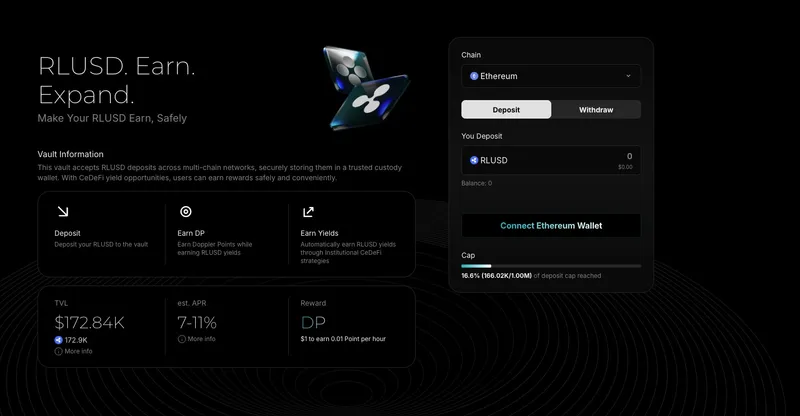
XDP price prediction from six published forecasts: bear, base and bull cases for 2026, 2027 and 2030 against $0.0155 on 8 November 2026 and the 2027 vesting.
CP trades at $0.0073, 84% under its September high. We compile published Cluster Protocol forecasts and test them against the 2027-2030 vesting calendar.

By Mikko Mikailov8 min read

CP traded at $0.00733 on 8 November 2026, 84% below the $0.04629 high it printed on its first trading day, 2 September 2026 (CoinGecko). Published forecasts for Cluster Protocol are thin, and the higher ones were computed from September prices that no longer exist. After we rebased them, the median path places CP at $0.0066 by end of 2026, $0.0077 by end of 2027 and $0.0089 by end of 2030. The variable that decides which scenario plays out is not the AI narrative. It is whether paid usage of the network grows before investor and team tokens start to vest in September 2027. On the data available today, we place CP closer to the bear case than to the median.
Cluster Protocol (CP) price and forecast
Loading price
| Year | Bearish | Base case | Bullish | Base vs today |
|---|---|---|---|---|
| 2026 | $0.0056 | $0.0066 | $0.0092 | |
| 2027 | $0.0051 | $0.0077 | $0.0139 | |
| 2030 | $0.002 | $0.0089 | $0.02 |
The forecast for this coin is being updated for the new year.
There is no 12-month history to analyze. CP is ten weeks old. Spot trading opened on KuCoin at 15:00 UTC on 2 September 2026 after a one-hour call auction, with OKX, Bitget and Gate listing the same day and Coinbase three days later. CoinMarketCap records an opening print of $0.199 on 2 September. CoinGecko, which filters thin opening trades, puts the all-time high at $0.04629. We use the CoinGecko figure. The $0.199 print reflects an empty order book in the first minutes, not what anyone paid in size.
| Date | CP price | What happened |
|---|---|---|
| 2 Sep 2026 | $0.04629 | First trading day, high on CoinGecko |
| 5 Sep 2026 | $0.03049 | Coinbase debut, intraday low $0.02919 |
| 24 Sep 2026 | €0.01118 | Down 8.87% on the day (Finary, EUR quote) |
| 5 Nov 2026 | $0.007336 | Down 35.63% over 30 days, no project news (CMC AI) |
| 8 Nov 2026 | $0.00733 | Market cap $10.15M, FDV $36.6M (CoinGecko) |
The decline has no single cause. Listing-week supply came from airdrop and launchpool recipients, and Bitget alone distributed 7,777,777 CP through its Launchpool. Then the AI-token sector lost bids. By early November, CMC's daily notes described CP as moving with the market, with no catalyst of its own.
Liquidity thinned out along the way. CoinGecko showed $0.79M in 24-hour volume on 8 November, and 30.2% of it went through Upbit's CP/KRW pair. Open interest on perpetual futures stood at $3.41M. That is a third of the circulating market cap, which tells us leveraged positioning, not spot demand, moves this price on a typical day.
The maximum supply is fixed at 5 billion CP, all minted at genesis. Launch circulation was 1,369,091,667 CP, or 27.38%, drawn from community, liquidity and treasury pools. No team or investor tokens circulated at launch (KuCoin, Bitget Academy).
| Allocation | Share | CP | Vesting |
|---|---|---|---|
| Community | 40.38% | 2,019M | Not specified |
| Foundation | 21.00% | 1,050M | Not specified |
| Team & Advisors | 17.00% | 850M | 18-month cliff, 24 months linear |
| Series A & Strategic | 9.33% | 466.5M | 12-month lock, 24 months linear |
| Liquidity | 8.00% | 400M | Released at launch |
| Seed | 4.29% | 214.5M | 12-month lock, 24 months linear |
From the published terms we derive the calendar. Seed and Series A tokens, 681M CP in total, start to release in September 2027 at 28.4M CP per month. Team tokens follow in March 2028 at 35.4M CP per month. Between March 2028 and September 2029 the two streams overlap, and 63.8M CP reach the market each month. Measured against today's 1.385B circulating supply, that equals 4.6% new supply per month. Bitget Academy states full circulation by month 42, which matches March 2030.
In our assessment this calendar matters more than any chart pattern. Investors raised $7.75M across two rounds, and named Series A backers include DAO5, Paper Ventures, JPEG Trading and Mapleblock Capital. At $0.00733, their 681M tokens are worth $4.99M. Round prices are not public, so we cannot say who sits at a loss. But the gap between the raise and current value is narrow, and narrow gaps tend to end in selling once tokens are liquid.
Two data problems are worth stating plainly. Yellow's asset page showed a circulating supply of 2,685,758,667 CP at one point, nearly double CoinGecko's figure. Tokenomics.com still lists an older 1-billion-supply scheme dated April 2026. Neither matches the official 5B disclosure. We use the official figures.
Seven sources publish numbers. None of them is an analyst model built on usage data.
| Source | Published | Base price used | Target |
|---|---|---|---|
| CoinCheckup | 8 Nov 2026 | $0.0073 | $0.00558 to $0.00596, Dec 2026 |
| OKX | Nov 2026 | $0.0077 | $0.0094 by 2030 |
| Coinbase | Oct 2026 | $0.0098 | $0.02 by 2030 |
| Bitget | Oct 2026 | $0.0132 | $0.01707 by 2030 |
| WEEX | 4 Sep 2026 | $0.0333 | $0.03668 by 2027 |
| OneBullEx | 6 Sep 2026 | $0.0316 | $0.0353 by 2027 |
| CoinGabbar | 5 Sep 2026 | $0.0305 | $0.03854 to $0.04357 recovery |
CMC AI published two outlooks, on 26 October and 5 November 2026, with no price targets. Its thesis is that usage-driven demand has to outpace dilution from investor and team vesting. We agree with that framing. KuCoin's research note priced CP at $0.10 ($500M FDV) and $0.20 ($1B FDV). KuCoin labels these figures illustrations, not forecasts, and at 13.6 to 27 times the current price they sit outside our range.
Four of the seven sources apply a fixed 5% annual growth rate to whatever the price was on the day the page loaded. Their output reflects the date, not a view. We rebased all four to the 8 November price of $0.00733, which collapses them into one path. Then we applied these rules:
If the market assigns CP the same dollar value after full vesting as it does today, the price falls to $0.0020 by 2030. This is plain dilution arithmetic. Nothing has to go wrong for it to happen, only nothing has to go right. On the way, the 2027 figure of $0.0051 reflects the first four months of investor releases.
Signals that point toward this path:
The base case places CP at $0.0066 at end of 2026, $0.0077 at end of 2027 and $0.0089 by 2030. At that level FDV reaches $44.5M, 22% above today. It assumes that new demand matches new supply, which is a demanding condition for a token whose supply grows 4.6% a month during 2028 and 2029.
If Cluster's gateway, which the project says routes calls to 500+ models through an OpenAI-compatible API, turns into measurable CP-settled revenue, the bull case puts CP at $0.0139 in 2027 and $0.0200 in 2030. The second figure means a $100M FDV. That is still under a quarter of the $161M FDV DefiLlama showed on 5 September.
What the bull case needs, in order:
In our assessment, the evidence available in November 2026 sits between the bear and base cases, closer to the bear. The base case requires conditions CP does not meet today. Our reasons are below:
Low-float, high-FDV launches distributed through airdrops and launchpools have a record. Between 2024 and 2026 the typical outcome was a long slide after listing, and few returned to listing-week prices. CP fell 84% in ten weeks. That fits the pattern rather than breaking it.
None of this rules out sharp moves up. RSI stood at 26.96 on CoinCheckup in early November, and the price sat 5% above its all-time low. With open interest equal to a third of market cap, a short squeeze could lift CP 30% to 50% in days. Such a move would come from derivatives mechanics. It would not change the supply calendar.
Our assessment would shift toward the base or bull case on four developments:
Every scenario above assumes CP keeps trading on the venues it trades on now. These risks could break that assumption:
For readers in Canada, CP gains and losses fall under the same capital or business income rules as other tokens, covered in our crypto tax guide for Canada. For comparison with an AI-adjacent token at a later stage, see our Ondo price prediction.

Mikko has been writing about money since 2015, covering payment services, trading platforms and crypto for readers in several markets. He leads exchange and wallet reviews at CryptoInfoBase.
XDP price prediction from six published forecasts: bear, base and bull cases for 2026, 2027 and 2030 against $0.0155 on 8 November 2026 and the 2027 vesting.
KOR price prediction after a 96% post-listing crash: bear, base and bull cases for 2026 to 2028 at $0.0013 on 8 November 2026, plus the November 2027 cliff.
MCAT trades at $0.59 with only 9.4% of supply circulating. We compile published MarsCat forecasts and test each scenario against who holds the other 90.6%.